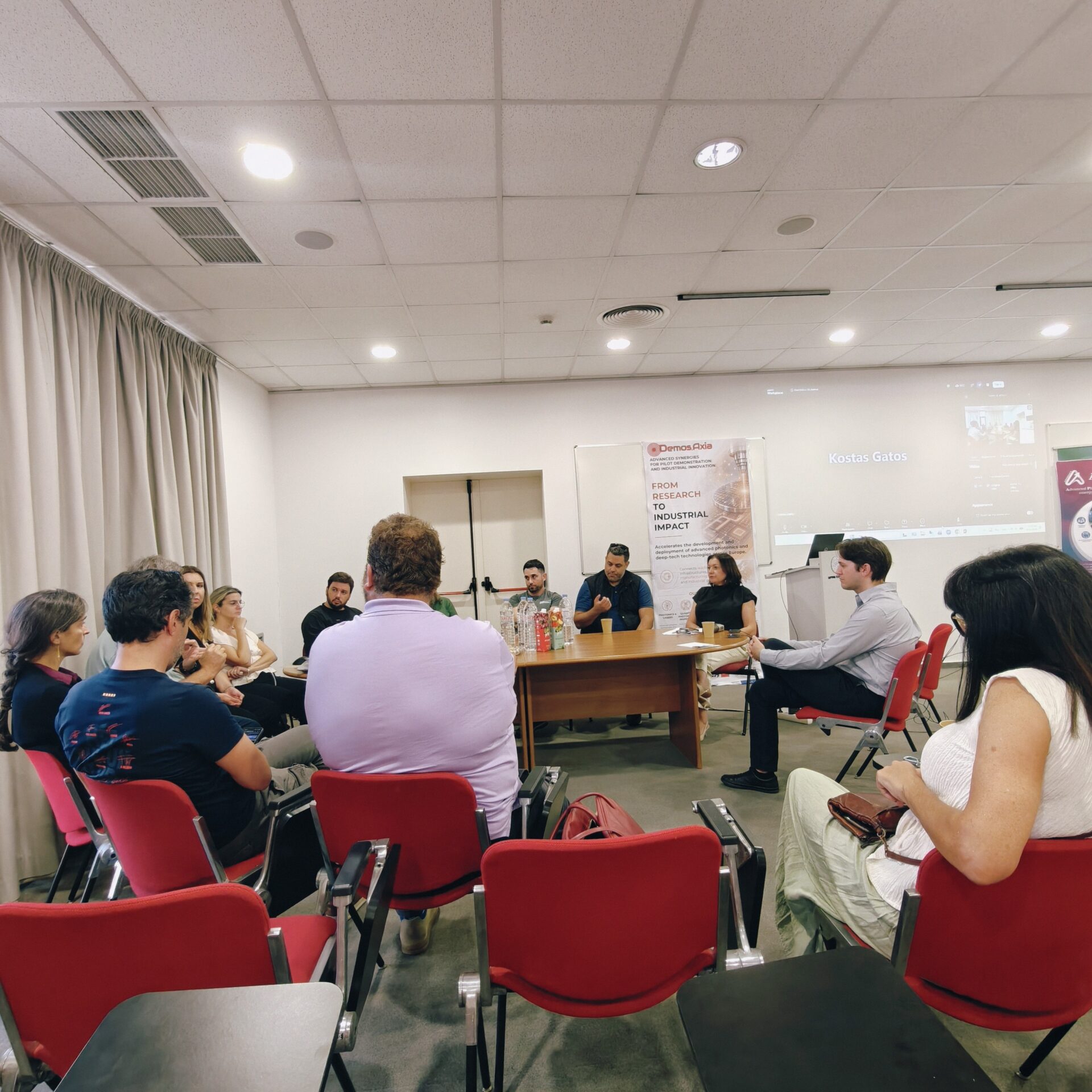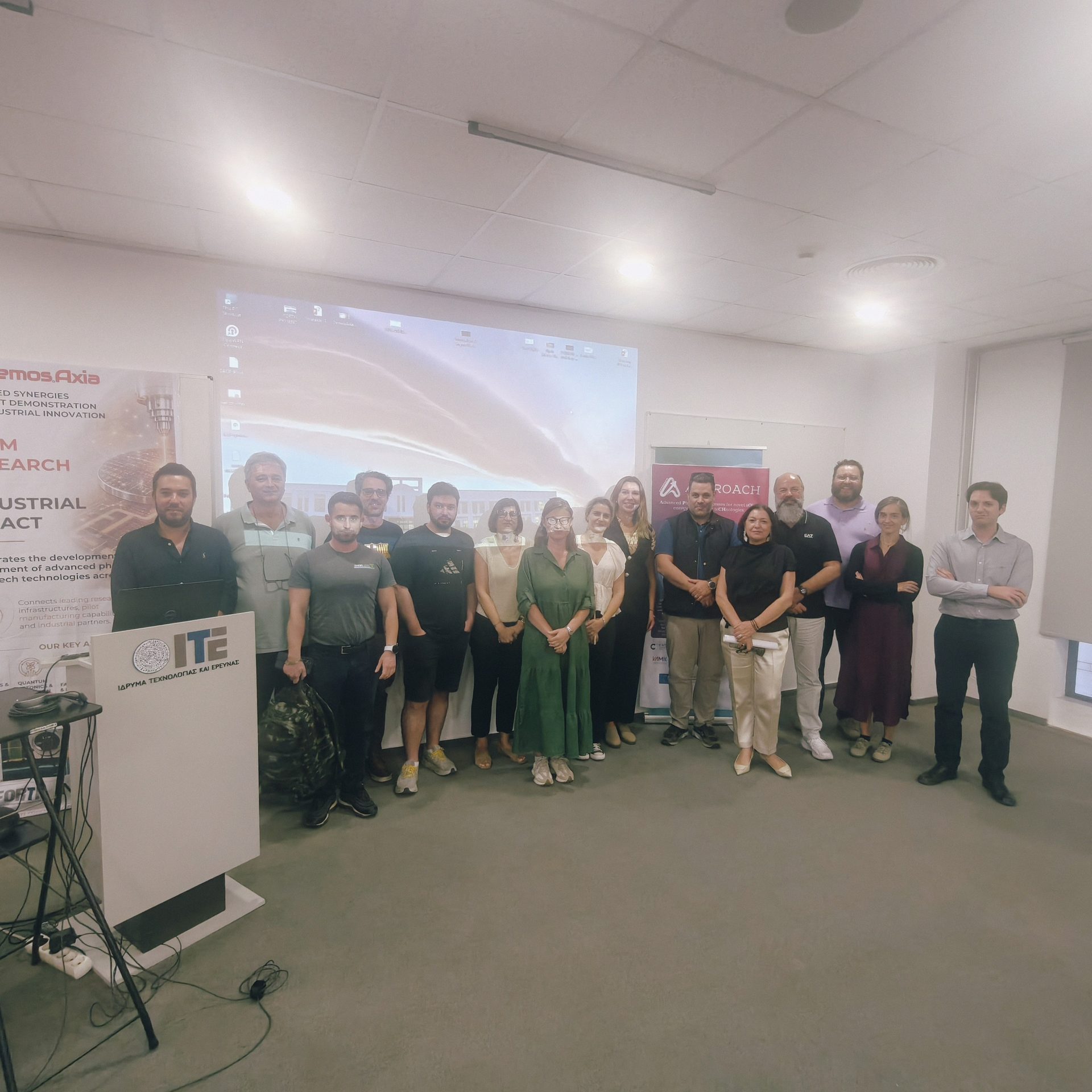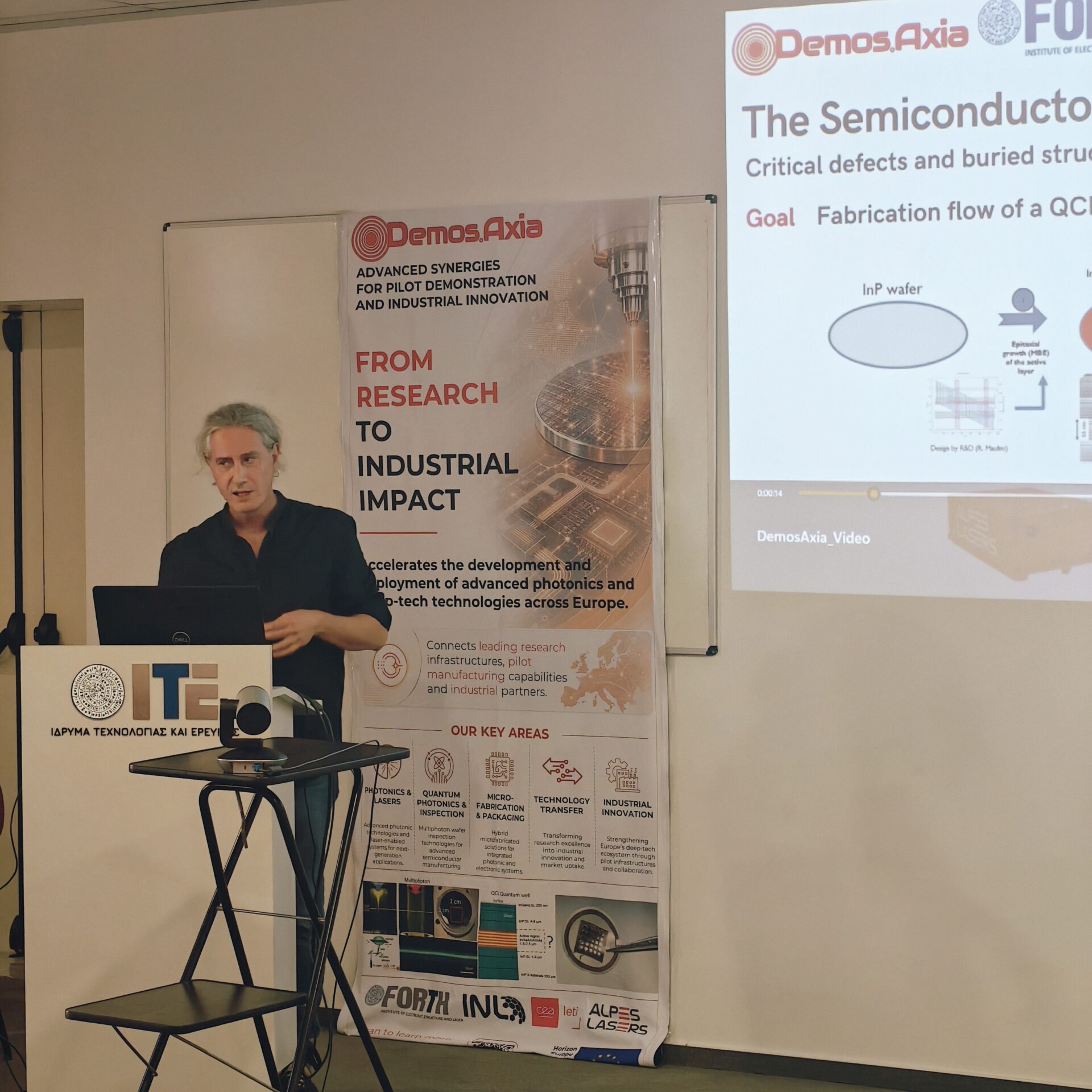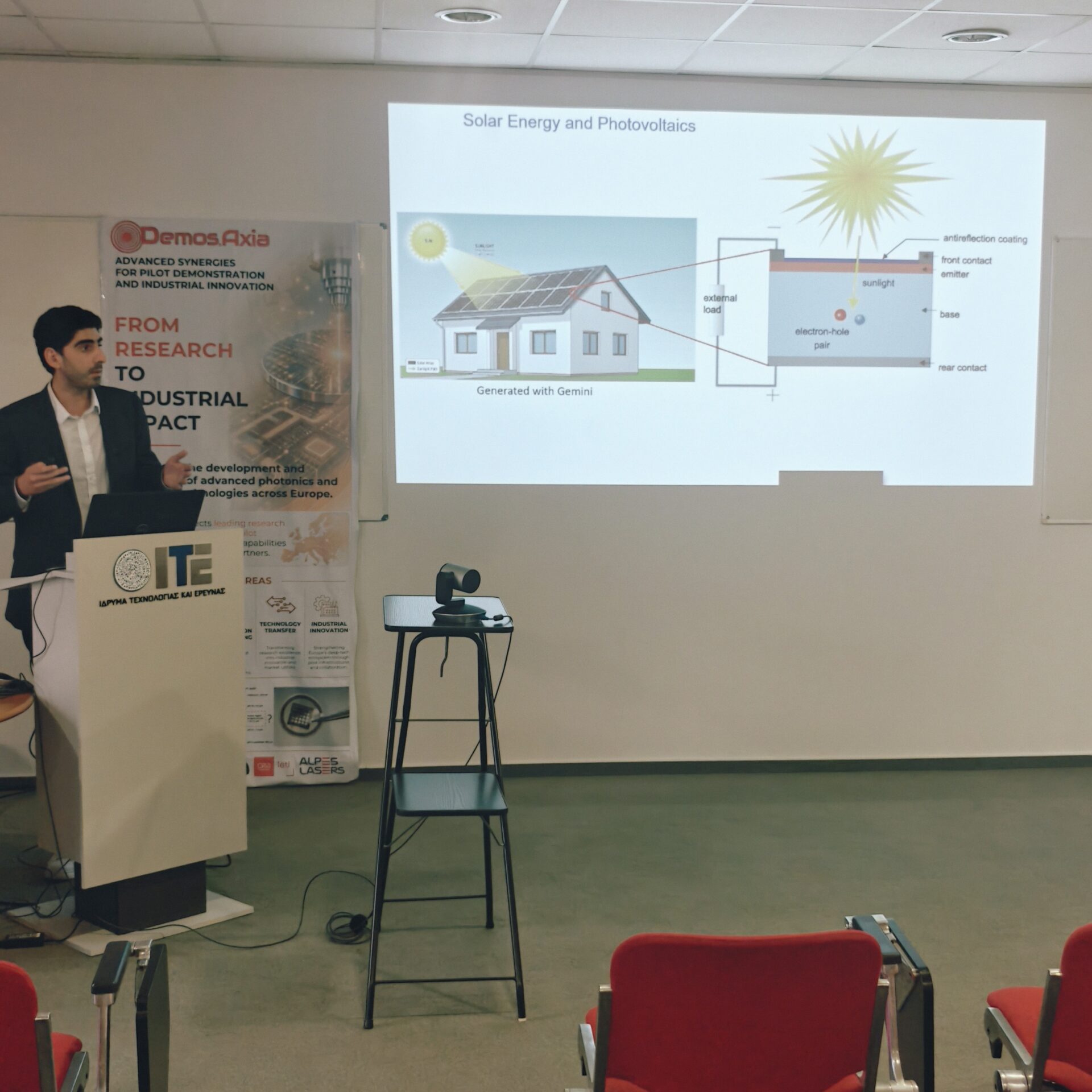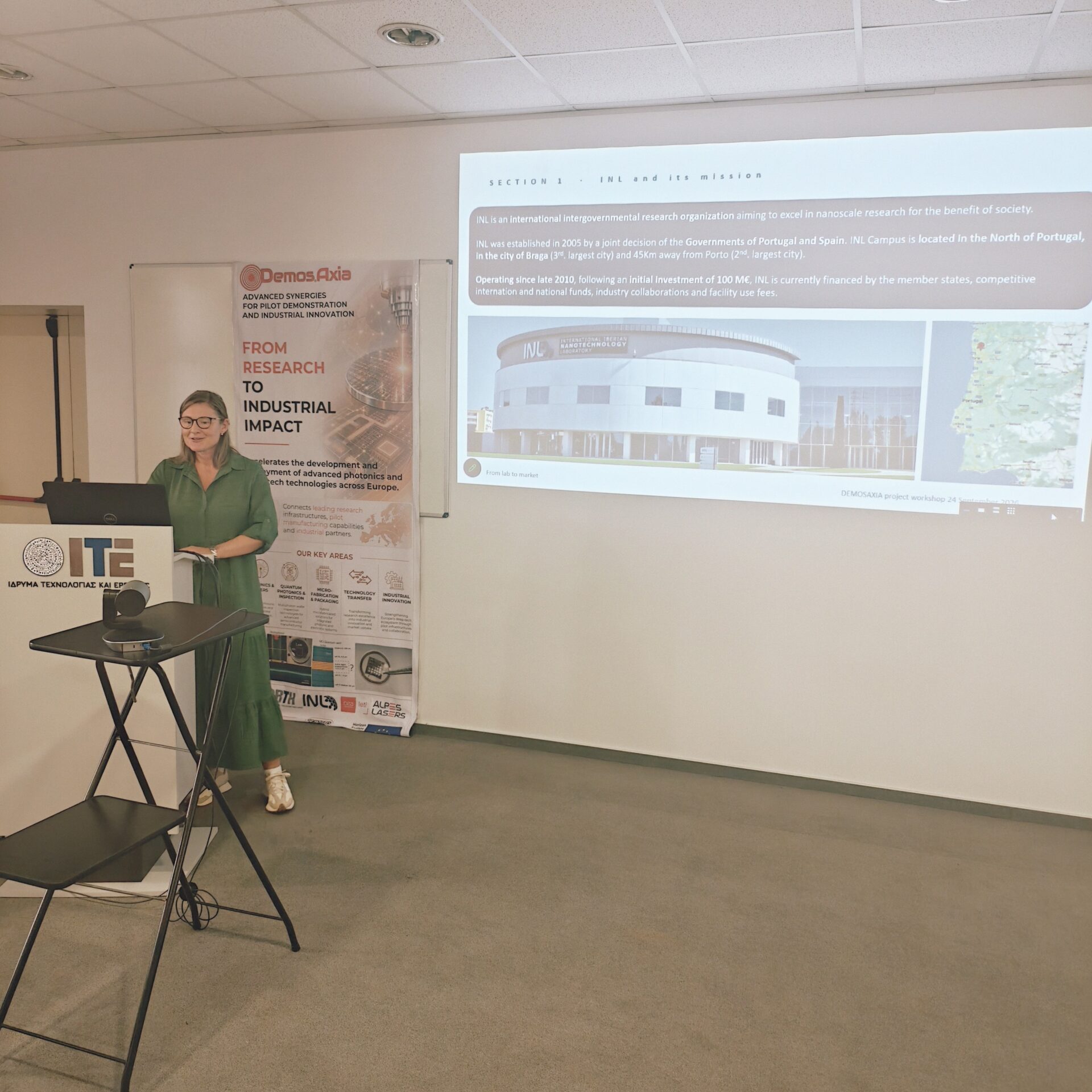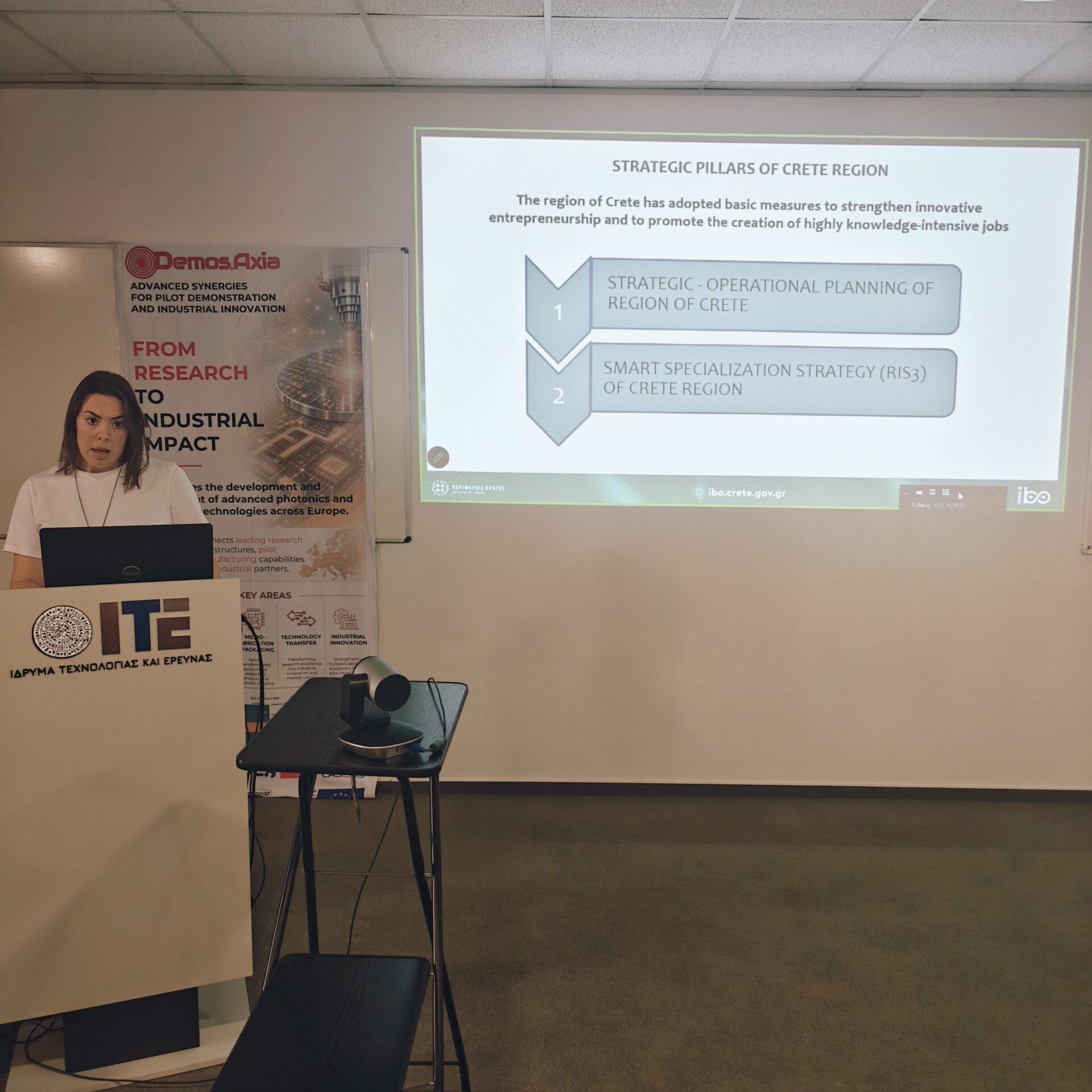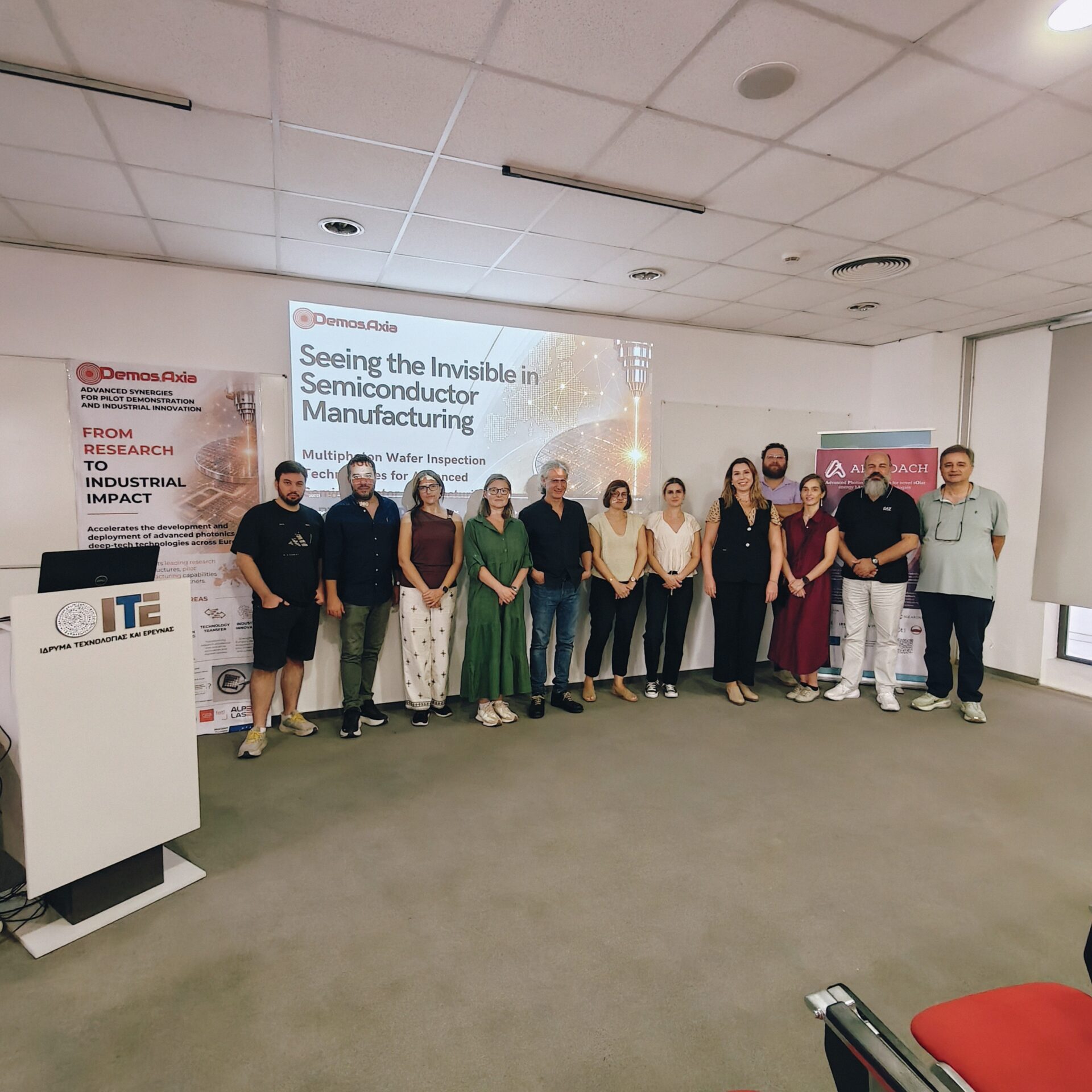
On 23–24 September 2026, the Foundation for Research and Technology – Hellas (FORTH) hosted the DemosAxia workshop on research valorisation, IPR, technology transfer and industry collaboration. The event took place at the Vasileios Dougalis Amphitheater in Heraklion, Crete. It brought together researchers, technology transfer experts, industry representatives and regional innovation stakeholders. Their shared goal was to explore how research results can move from the laboratory to the market and to society.
Day 1 – From Research Results to Value
The first day opened with a welcome by the FORTH team, which introduced the DemosAxia project and the objectives of the workshop.
Manolis Vergetakis, Technology Transfer Consultant & Commercialisation Officer at PRAXI Network, set the scene with a session on research valorisation. He walked through the path from research outputs and publications to intellectual property, prototypes, partnerships and practical applications. He also covered the roles of researchers, technology transfer offices and entrepreneurs along this path.
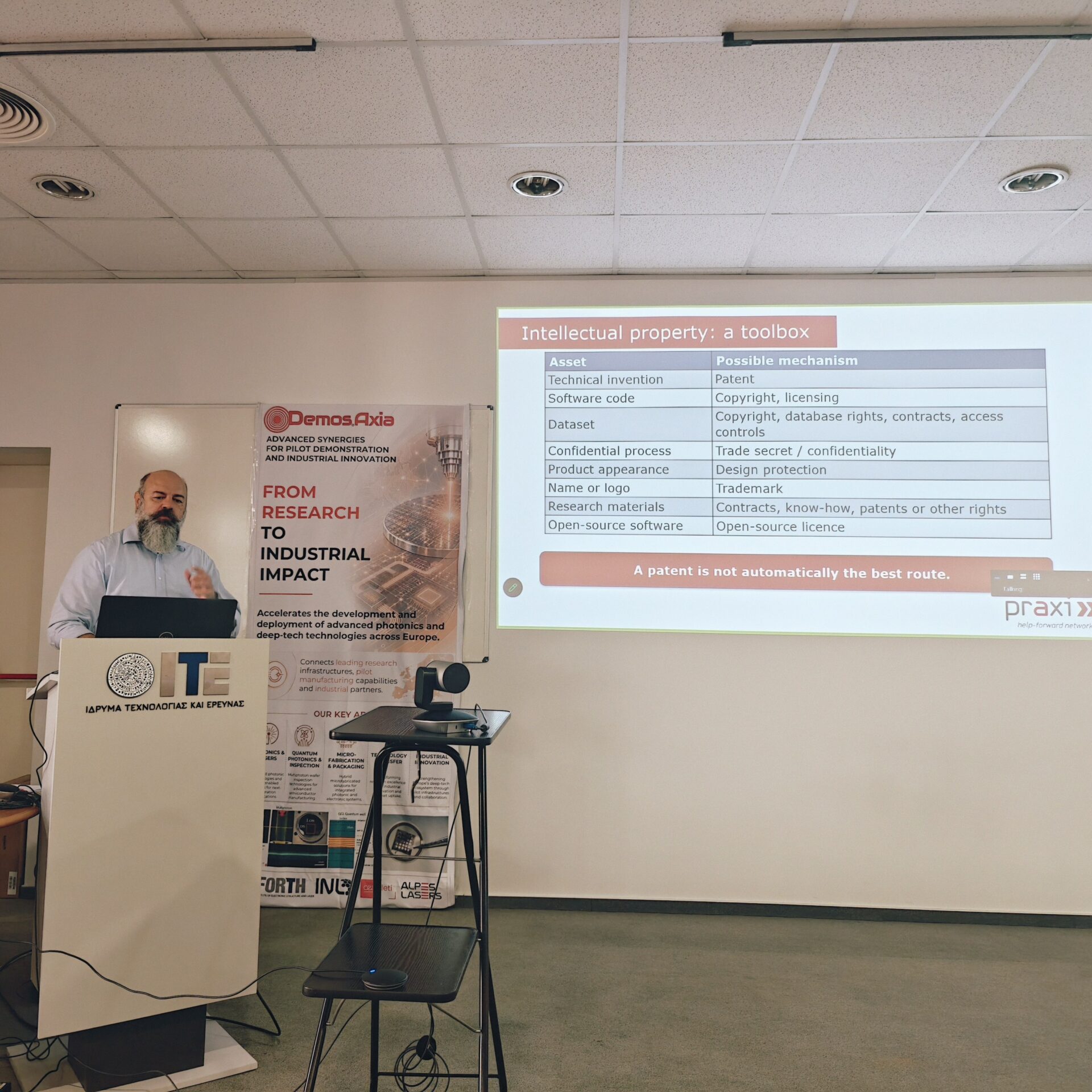
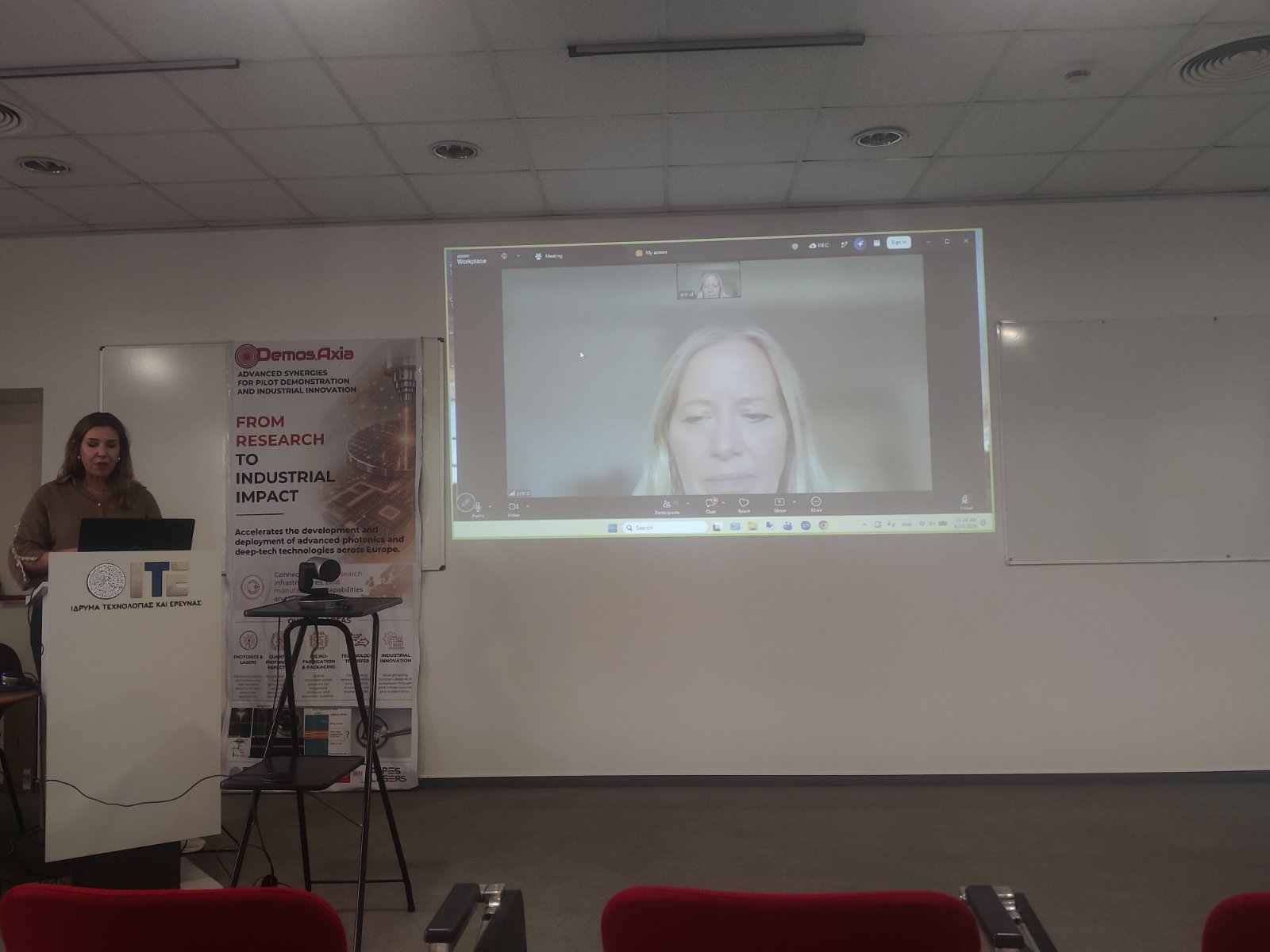
Astrid Wiedersich Avena of the SEA IP SME Helpdesk followed with a practical presentation on IPR and exploitation strategies in collaborative projects. It covered the distinction between background and foreground IP, ownership and access rights, confidentiality agreements, licensing and spin-off creation, using real-world examples.
Dr George Kakavelakis, Assistant Professor at the Hellenic Mediterranean University and Co-Founder and former CTO of GraphEnergyTech Ltd., spoke about building an entrepreneurial culture at universities. He drew on his own experience at the University of Cambridge, where he went through the patenting process and spun out his research. He shared practical strategies for moving “from papers to impact.”
In the afternoon, Prof. Yeoryios Stamboulis of the Department of Economics, University of Thessaly, presented the first part of “Innovation & Impact Pathways.” He argued that patenting is only one of several routes to exploitation and presented a framework for structuring IP strategy and choosing among them.
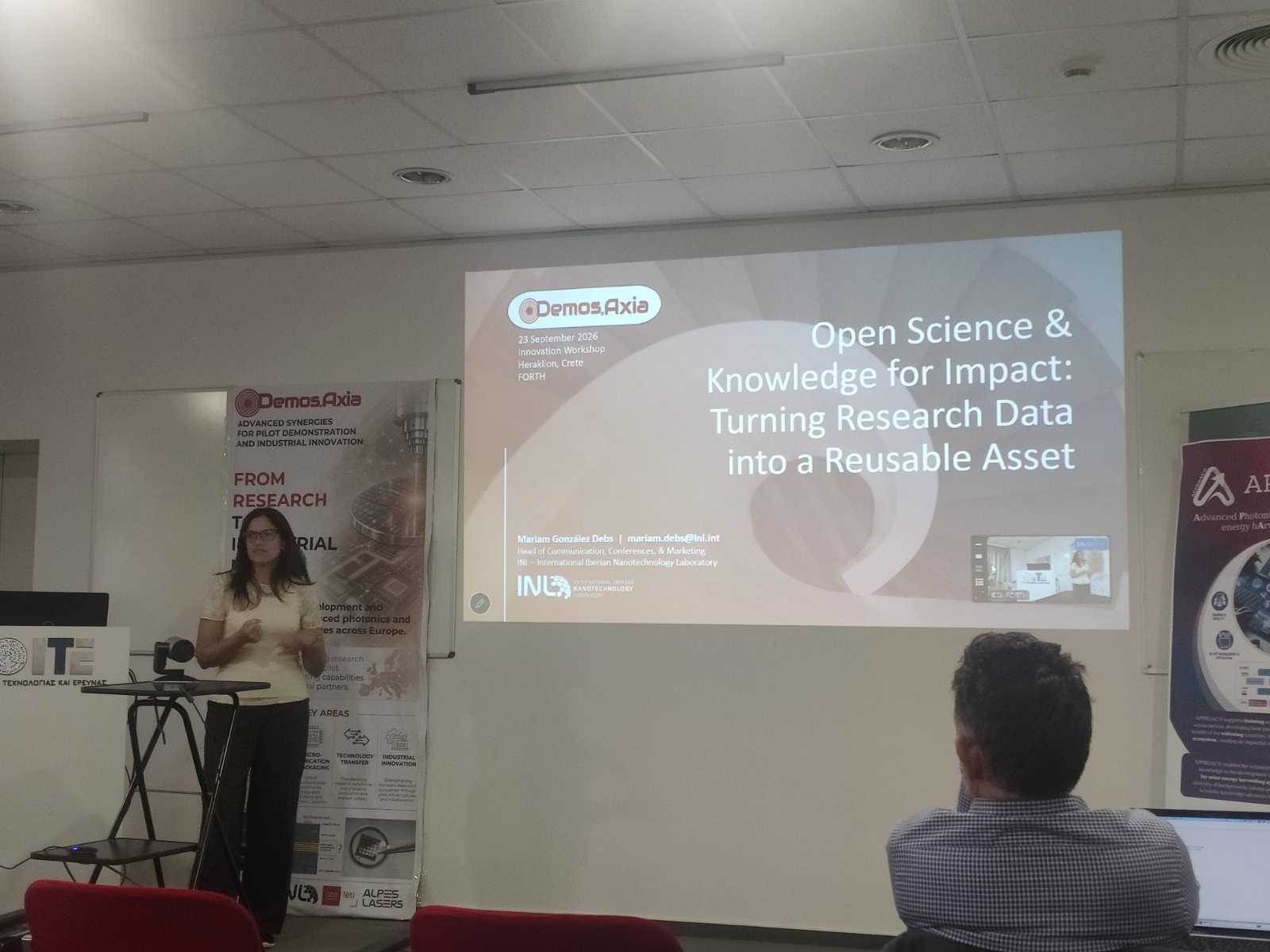
The day closed with an interactive session led by Dr Mariam González Debs, Head of Communication, Conferences & Marketing at INL. It focused on strategic openness in research and innovation: when knowledge should be shared openly, and when access may need to be delayed, controlled or restricted. Participants worked on these questions through group exercises. An open discussion then wrapped up the day.
Day 2 – From Innovation to Industry and Impact
Prof. Stamboulis opened the second day with “Innovation & Impact Pathways II.” This session looked at the different perspectives and time horizons of researchers and industry, and at tools for understanding how industries and technologies evolve.
Philippe Caillol, Innovation Director at CEA, presented CEA’s innovation model as a DemosAxia Lighthouse of Innovation. The model runs from interdisciplinary research and co-innovation with industry to prototyping, demonstration and technology transfer. The case study contributes to the project’s Recipes of Innovation guidebook.
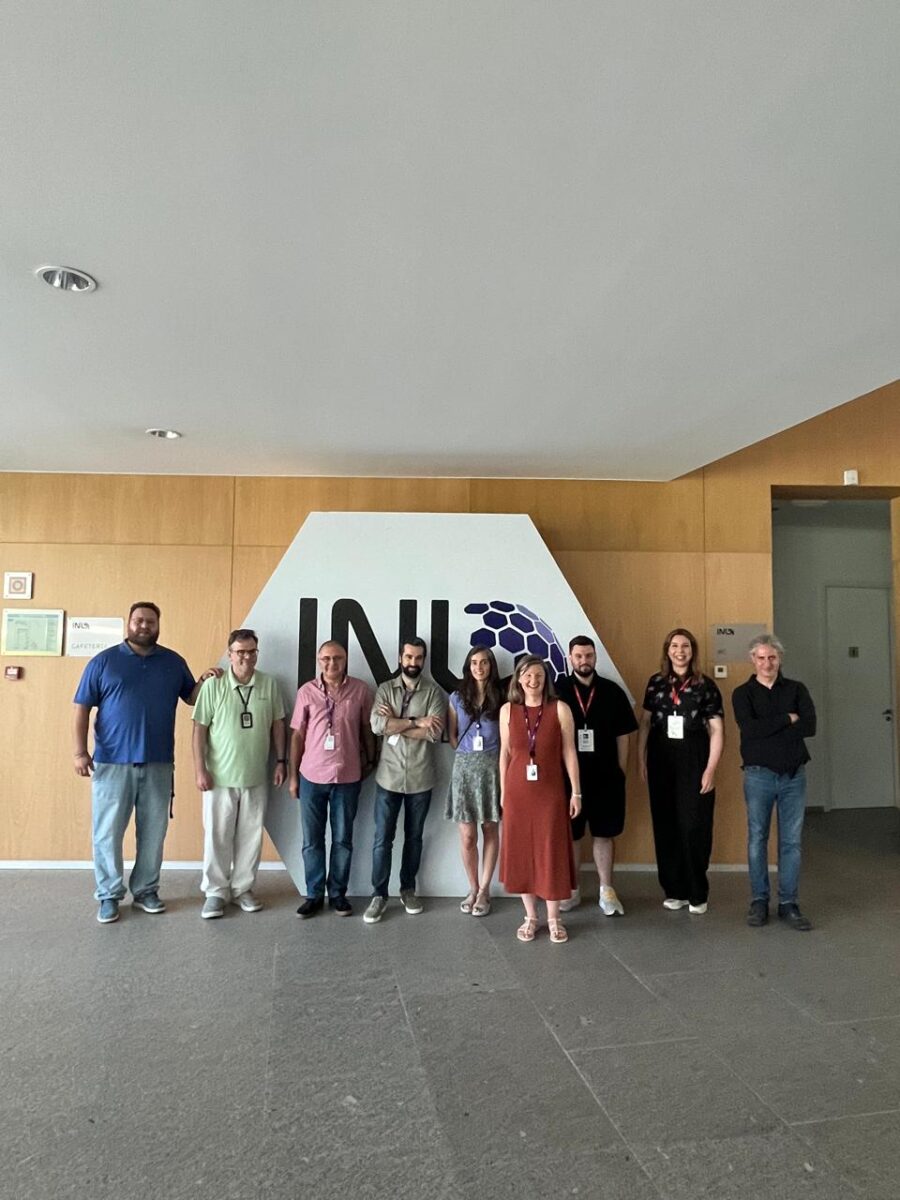
Brigita Jurisic, Business and Strategic Relations Officer, and Margaret Costa, Head of the Quality Management Unit, both from INL, showed how standards and regulations act as drivers of collaboration. They illustrated how compliance reduces risk and builds industry confidence, with real examples from contract R&D, collaborative research and IP licensing.
Eirini Patsiali presented the Innovation Business Observatory (IBO) of the Region of Crete. She explained how the IBO collects and analyses data on entrepreneurship, innovation, research and investment to support evidence-based policy and a stronger regional innovation ecosystem.
The afternoon turned to pilot lines and industrial quality control:
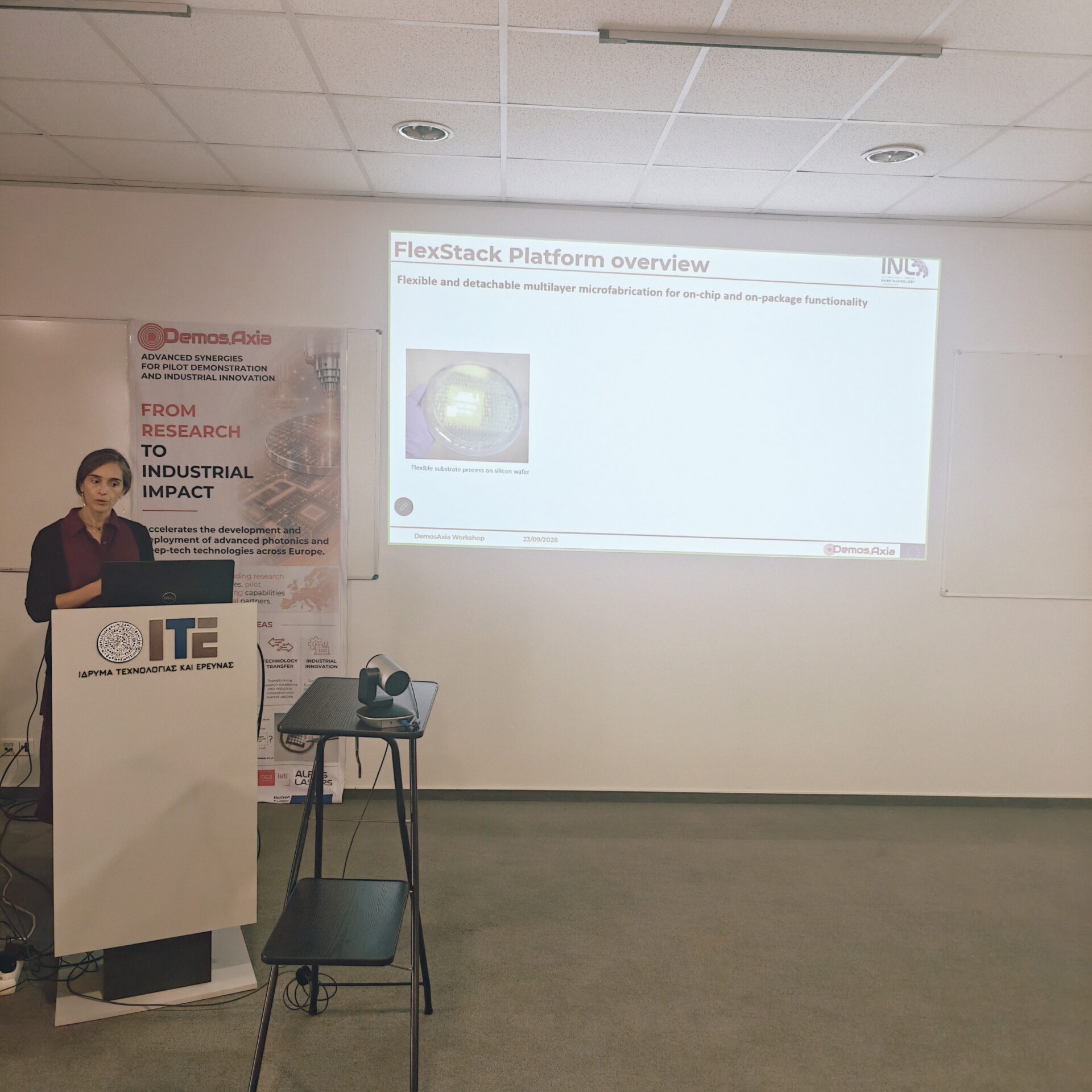
- Dr Rosana Dias (INL) presented INL’s microfabrication and integration capabilities on flexible substrates, including the FlexStack platform.
- Dr Sotiris Psilodimitrakopoulos (FORTH) showed how multiphoton microscopy enables non-invasive, three-dimensional quality inspection of quantum cascade laser wafers.
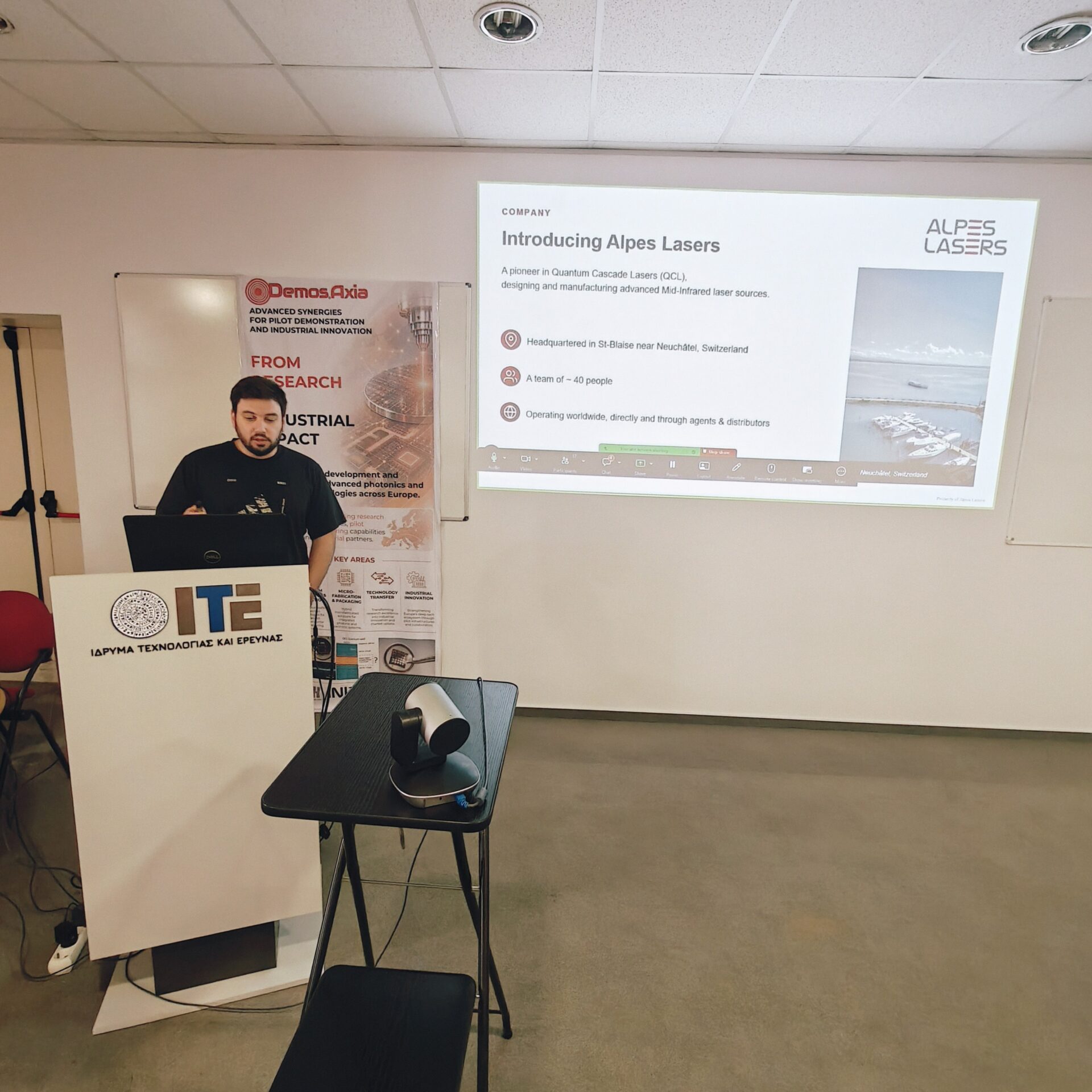
- Dr Dimosthenis Toliopoulos (ALPES Lasers) complemented this with the industrial perspective of a photonics SME. He used the DemosAxia collaboration with FORTH as a case study.
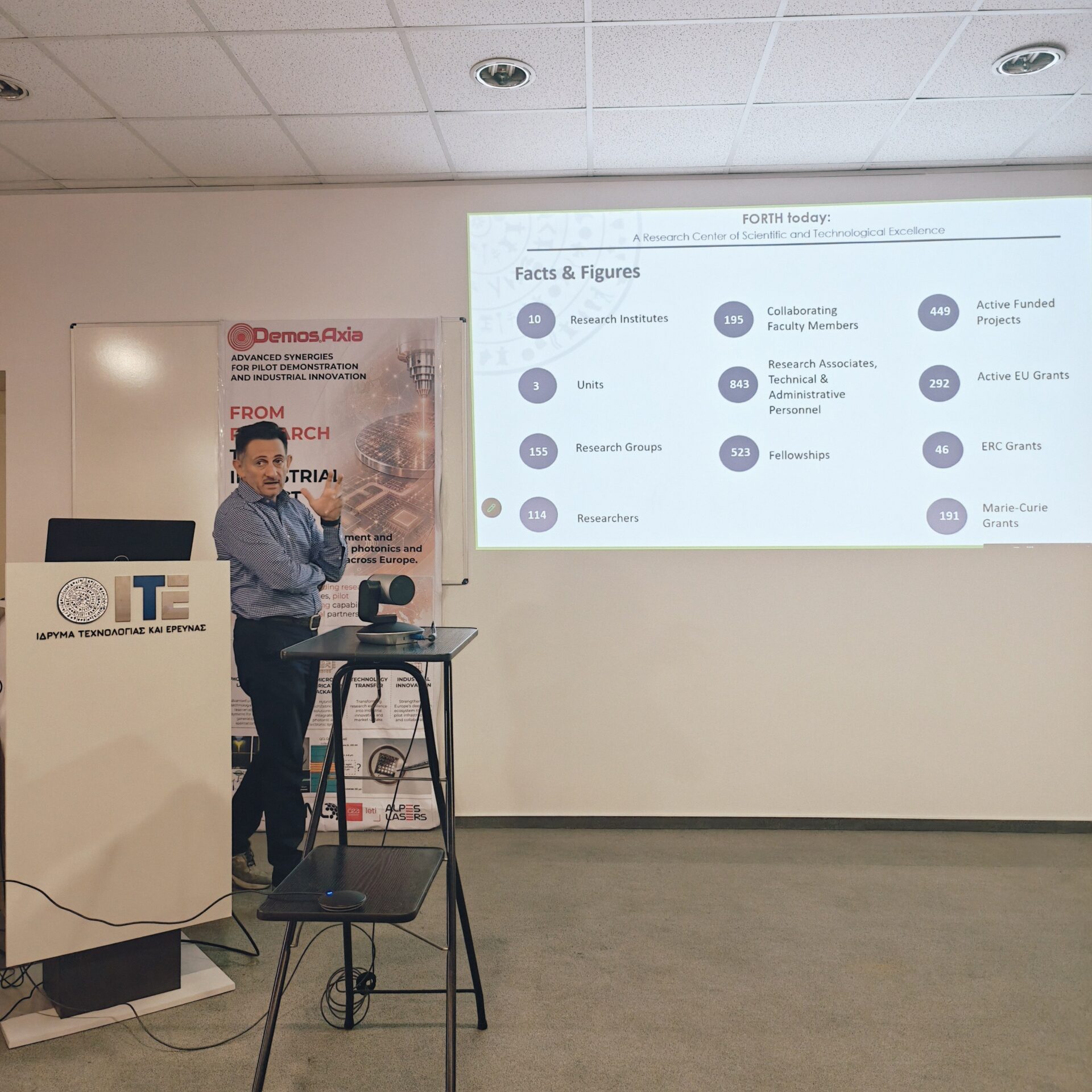
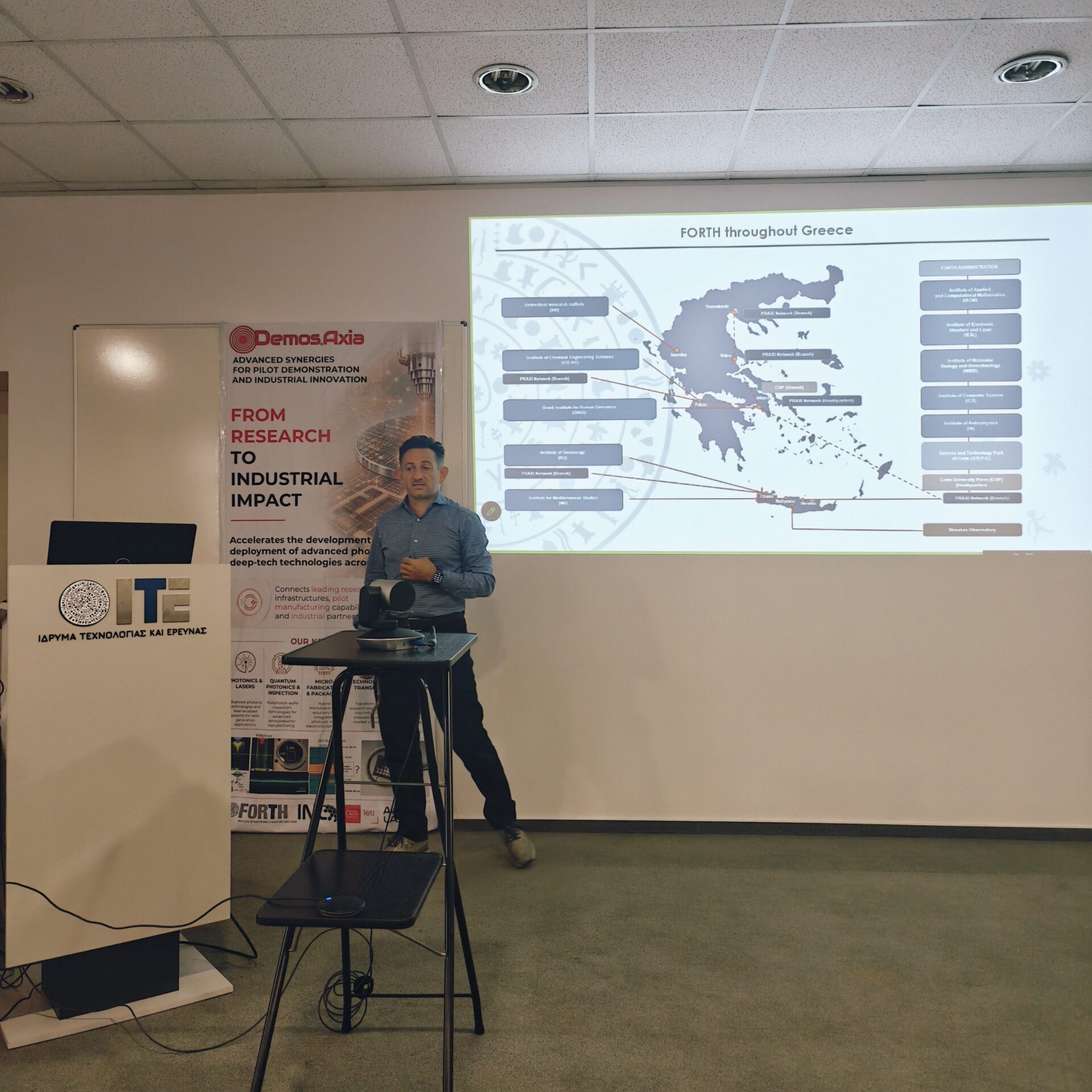
Dr Eleni Petala, Project Manager at FORTH, then offered a simple, researcher-centred framework of key questions for assessing the innovation potential of a promising lab result.
The day concluded with the panel discussion “Industry Needs & Market Opportunities.” The panel explored what industry is actually looking for, the barriers to adopting new technologies, and how research can better respond to market needs.
Thank you
We warmly thank all our speakers for their valuable contributions: Manolis Vergetakis (PRAXI Network), Astrid Wiedersich Avena (SEA IP SME Helpdesk), Dr George Kakavelakis (Hellenic Mediterranean University), Prof. Yeoryios Stamboulis (University of Thessaly), Dr Mariam González Debs, Brigita Jurisic, Margaret Costa and Dr Rosana Dias (INL), Philippe Caillol (CEA), Eirini Patsiali (Innovation Business Observatory, Region of Crete), Dr Dimosthenis Toliopoulos (ALPES Lasers), and Dr Sotiris Psilodimitrakopoulos and Dr Eleni Petala (FORTH).
Special thanks go to our panellists Alexandros Mimidis (Biomimetic), Lazaros Tsounis (PDOT), Michalis Panteris (PRAXI Network), Maria Petrantonaki (Regional Development Company of Crete – P.AN.ETAI.K.), Christina Stangel (FORTH) and Ivan Prieto (INL), who shared the stage with several of our speakers.
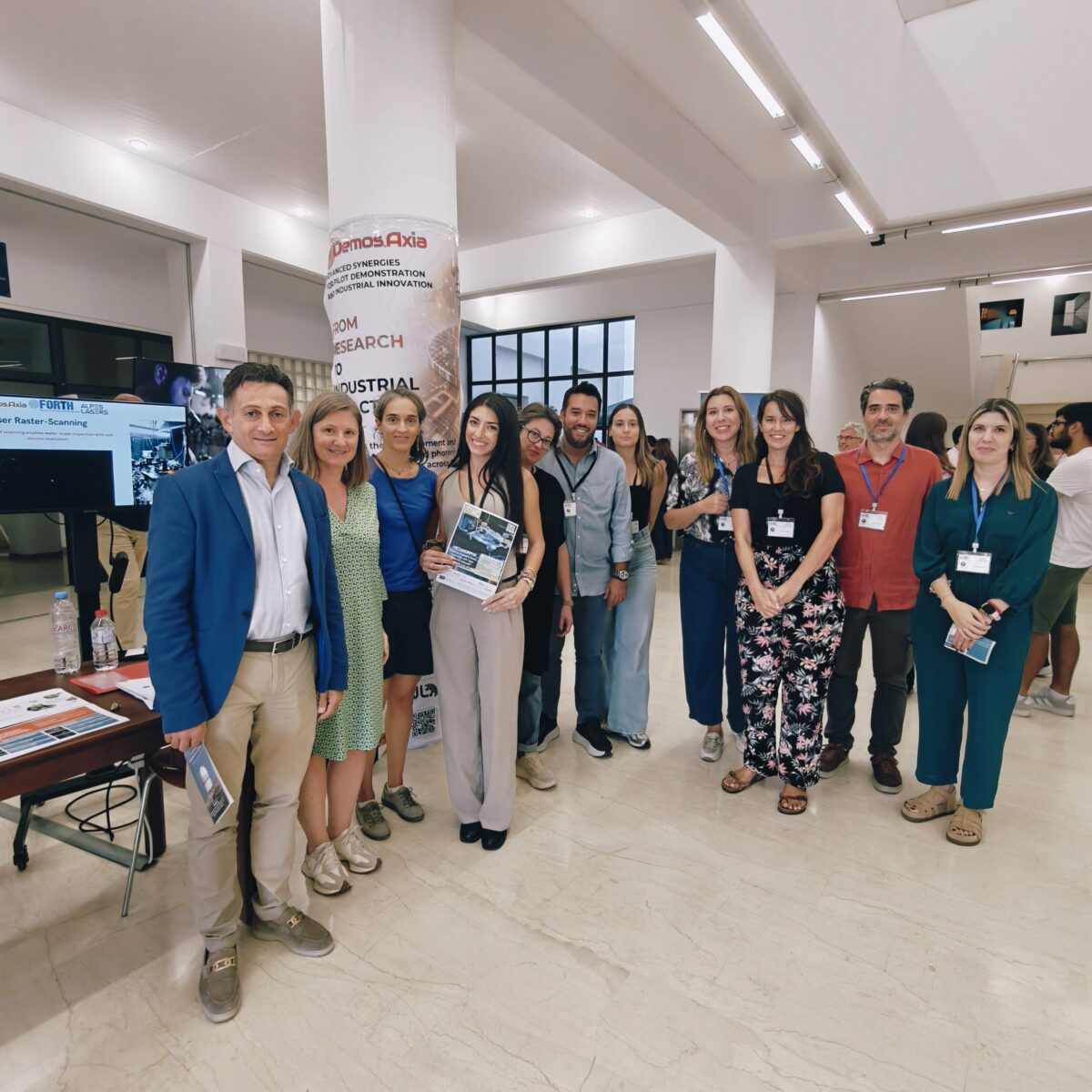
Finally, we thank all participants for their active engagement and lively discussions. The insights gathered during the workshop will feed into the DemosAxia Recipes of Innovation and the project’s next steps towards stronger innovation ecosystems across Europe.
DemosAxia has received funding from the European Union’s Horizon Europe programme under Grant Agreement No 101160387.